Search "how much does local SEO cost" and you get pricing tables. Retainers, hourly rates, project fees, tidy tiers from $300 to $9,500 a month. Useful if you are shopping for an agency. Useless if you are trying to answer the actual budget question: how much of my revenue should go to local SEO, and what should that money buy?
This guide answers that, for any small business. Not contractor tier tables, we keep those in our contractor pricing guide, and this post deliberately does not repeat them. This is the budgeting framework: the revenue rule, the job-value math, what each dollar buys in real hours of work, the DIY-vs-hire test, and the AI-readiness line item nobody else budgets for.
On This Page
Start With Revenue, Not Pricing Tables
Pricing tables answer what vendors charge. Your budget should answer what the channel is worth to you. The standard starting point for small businesses is 5 to 10 percent of gross revenue for all marketing, and local SEO takes a share of that based on one question: how much of your business comes from local search?
If most of your customers find you by searching for what you do nearby, local SEO deserves a large share, often the largest single line in the marketing budget. If you run on referrals and repeat business with search as a supplement, a smaller share is rational. The percentage is a ceiling, not a target: it keeps you from spending like a national brand on a neighborhood business, and it keeps you from starving the channel that actually rings your phone.
Worked simply: a business doing $500,000 a year that earmarks 7 percent for marketing has $35,000 a year, about $2,900 a month, for everything. If local search drives half the leads, local SEO can reasonably claim half that line. You now have a budget grounded in your economics, not in someone's tier table.
The Job-Value Math That Sets Your Number
The revenue rule gives you a ceiling. Your job value gives you the floor. Run this math before you sign anything:
- Average job value. What one booked customer is worth, on average. A plumber's $450 service call and a remodeler's $25,000 project produce very different budgets, which is exactly why pricing tables mislead.
- Close rate. What share of qualified calls become paying jobs. If you close one in three, you need three calls per job.
- Break-even test. Multiply the jobs you need by your close rate to get the calls required, then check: does one or two extra jobs a month cover the spend? If yes, the budget is rational. If the spend needs ten extra jobs a month to break even and you currently get four calls, the budget is fantasy.
This is the test that kills bad budgets before they start. A business with a $600 average job and a 30 percent close rate needs about seven calls to produce two jobs, roughly $1,200 in revenue. A $500 monthly spend is defensible. The same spend for a business with a $150 average job and a 20 percent close rate needs far more volume than local search can plausibly deliver, and the budget should be smaller, or the strategy should be DIY. Your numbers, not anyone's tiers, decide.
What Each Budget Buys, In Hours
Every local SEO budget, DIY or hired, is really a purchase of hours. Translating dollars into hours is how you spot a bad deal.
A few hundred dollars a month buys roughly a handful of hours of real work: profile maintenance, review replies, a post or two, citation checks. That is a legitimate maintenance budget for a business that already ranks and just needs to hold position. It is not a growth budget, and anyone selling it as one is selling the label, not the labor.
A mid-range monthly spend buys a part-time specialist's week: ongoing review systems, new service and location content, listing management, and competitive monitoring. A large spend buys a team: content production, link building, multi-location management. The question is never "is $X too much." It is "does $X buy enough hours of the right work to move my market."
Two warnings from this math. First, suspiciously cheap offers fail the hours test: there is no version of $150 a month that buys real monthly work, so something automated or outsourced is happening, and automated local SEO is where penalties live. Second, Google itself warns that no one can guarantee a number-one ranking. Anyone whose pricing is built around a guaranteed position is pricing a promise they cannot keep.
The standard small-business marketing budget as a share of gross revenue. Local SEO's share of it should track how much of your business actually comes from local search.
DIY Or Hire: The Time-Value Test
The basics of local SEO, claiming and completing your profile, building a review system, cleaning up listings, publishing a few strong pages, take roughly 20 to 30 hours up front and a few hours a month after. That is the DIY price tag, and it is paid in evenings.
The hire decision is arithmetic, not pride. Multiply those hours by your billable rate. If 10 hours a month of your time is worth more than a retainer that buys 10 hours of a specialist's time, DIY is the expensive option. Owner-operators with a $200 billable hour routinely "save" $800 a month doing their own SEO at a true cost of $2,000 in unbilled time. The spreadsheet does not care about your work ethic.
The hybrid most small businesses land on: DIY the foundations in month one, hire for the compounding work after. Foundations are checkable and finite. The ongoing engine, review velocity, content, competitive response, is where hired consistency beats owner willpower. Our DIY checklist is the month-one program, and our agency hiring questions protect the budget when you decide to spend it.
Budget AI Readiness As A Line Item
Nobody's pricing table has a line for this, and it is the fastest-growing reason budgets underperform. When customers ask AI assistants for recommendations, the businesses that get named are the ones with complete structured data: full service listings, LocalBusiness schema on their sites, descriptive review text, and citable content the assistant can quote.
Treat AI readiness as a line inside your content and review budget, not a separate product. It means budgeting for: complete service data everywhere (not just a homepage), one strong citable page per core service, a review system that generates descriptive reviews rather than star counts, and a monthly check of whether assistants actually name you for your money queries. The work is the same work that ranks you on Google, which is the good news: you are not buying a second strategy, you are aiming the first one at a second reader.
For contractors who want the trade-specific version of all these numbers, the contractor pricing guide has the tier breakdowns and break-even math this post deliberately skips.
Scaling Spend As Results Compound
Local SEO is one of the few marketing channels where the asset appreciates. Reviews stack, content compounds, links persist. That changes how you scale: start at the budget your job-value math justifies, hold it for 90 days, then reinvest from results, not from hope.
The scaling rule: increase spend when the channel is producing booked jobs at a cost per job you would happily pay again. If $800 a month is producing four booked jobs worth $600 each, the question is not whether to keep spending, it is how fast you can scale the inputs, more content, more reviews, more service coverage, before competitors respond. If 90 days of real execution produced nothing, do not increase the budget. Change the strategy or the operator first; more money into a broken system buys a more expensive broken system.
And keep the percentage discipline as you grow. The business that did $500,000 and spent 7 percent should not spend a flat $2,900 forever. As revenue grows, the budget grows with it, which is how a small business becomes the entrenched competitor newcomers cannot dislodge.
The One-Page Budget, Summarized
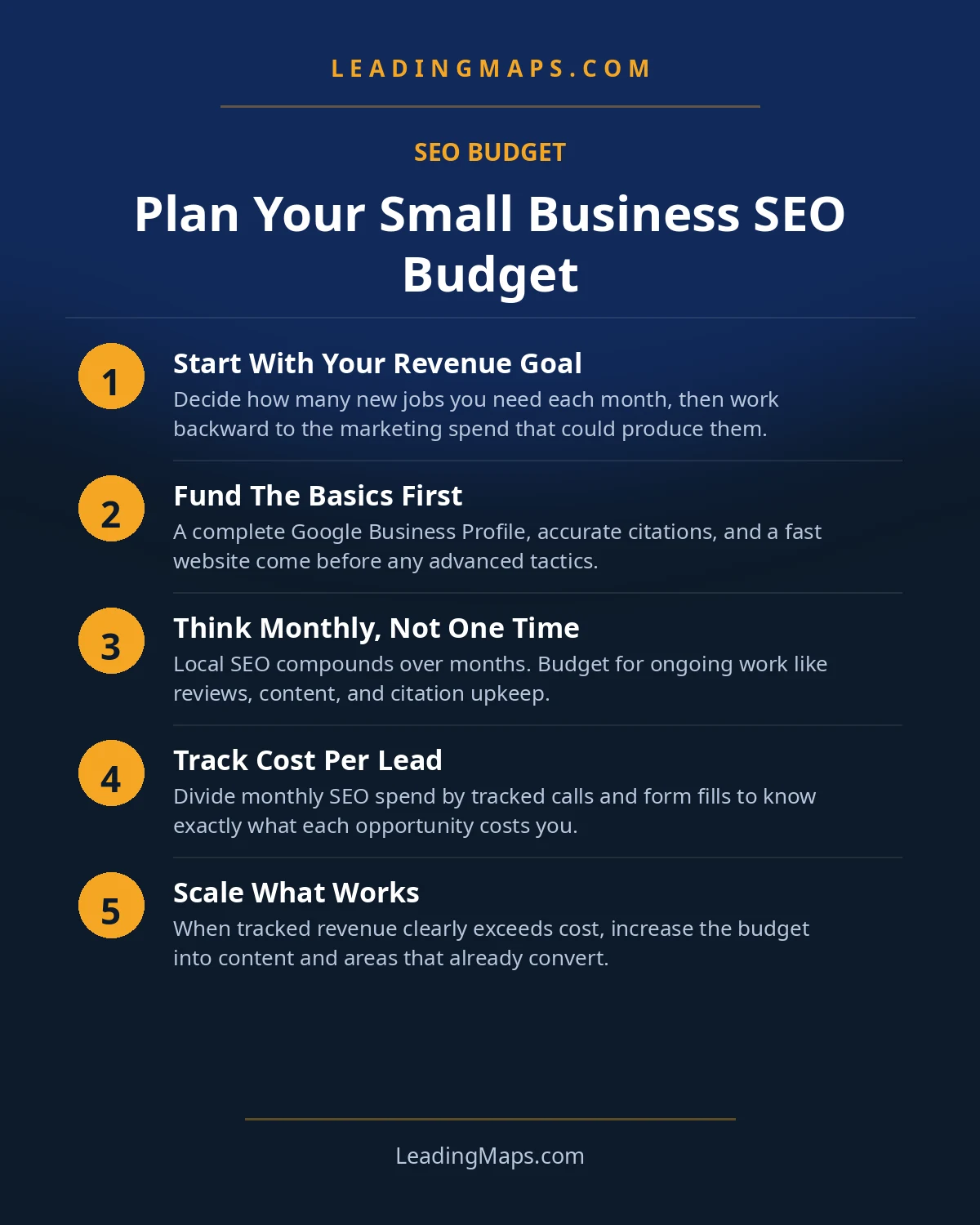
If you skimmed: set the ceiling at 5 to 10 percent of revenue for all marketing, give local SEO the share that matches its share of your leads, sanity-check the number against your job value and close rate, translate any quote into hours before you judge it, hire when your time costs more than the retainer, budget AI readiness inside content and reviews rather than as an add-on, and scale spend only off booked jobs, never off hope. Seven lines, no tier table required.
Budget Questions, Answered.
Start with 5 to 10 percent of gross revenue for all marketing, then give local SEO a share based on how much business comes from local search. For many small businesses that is a few hundred to a few thousand a month, but the right number comes from your job value and close rate, not a pricing table.
Usually yes, because local SEO is one of the few marketing channels where a small business can outrank bigger competitors on merit, proximity, and reviews rather than ad budget. The math to check: one new customer a month from local search should cover the spend. If your average job value makes that true, it is worth it.
Do the math on your time first. The basics, profile setup, review system, listing cleanup, take 20 to 30 hours up front and a few hours a month after. If your billable hour is worth more than a retainer for those hours, hiring is cheaper. Either way, learn enough to judge the work.
Measure calls and booked jobs, not rankings alone. Track where leads come from with a call tracking number and a simple intake question, then compare booked revenue against total spend each quarter. Expect 60 to 90 days before judging: local SEO compounds, and early flat months are normal before the curve bends.
Treat AI readiness as a line in your content and review budget, not a separate product. The work that makes you recommendable to AI assistants, complete service data, structured schema, descriptive reviews, and citable content, is the same work that ranks you on Google. Budget it as part of your organic and review systems, and test whether assistants name you.
Budget Against Reality, Not A Tier Table
Profile, Maps rankings, citations, reviews, competitors, plus whether AI assistants recommend you. A prioritized action plan, free, no pitch.
- AI visibility check, real homeowner prompts across ChatGPT, Perplexity, and AI Overviews, who gets named.
- Proposal scorecard, what your current or prospective agency should be doing, item by item.
- Competitor gap analysis, what the top 3 in your market are doing that you're not.
Get My Free SEO Audit
Delivered within 48 hours. Yours to keep.