Ask any agency about local SEO versus organic SEO and you will hear the same safe answer: you need both. Technically true. Practically useless. A plumbing company with a limited budget does not need a philosophy, it needs to know where the next dollar goes: the map pack or the content.
This guide answers that, for real businesses. Local SEO and organic SEO are not rivals. They are two tools that win two different kinds of jobs, and in 2026 a third development, AI answers, changed what the second tool is for. Below: the plain-English difference, which one wins which job, the reinforcement loop between them, and how to sequence your spend.
On This Page
The Difference, In Plain English
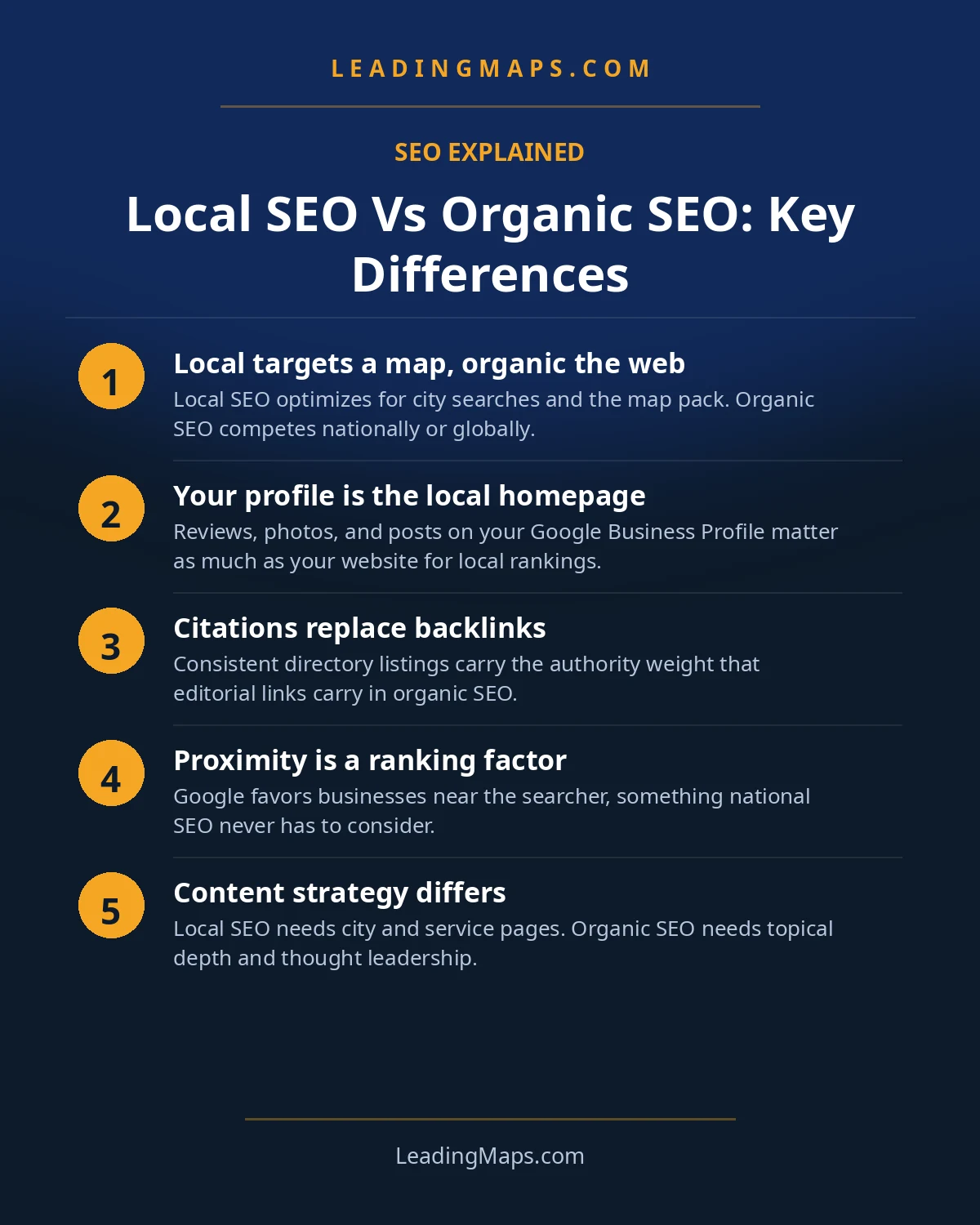
Local SEO optimizes your business to appear in location-based results: the map pack, Google Maps, and local listings. Its home base is your Google Business Profile, your reviews, and your citations. When someone searches "emergency plumber near me," local SEO is what decides whether your name is in those three boxes.
Organic SEO optimizes your website to rank in the classic results for any query, local or not. Its home base is your content, your site structure, and your backlinks. Google's own SEO Starter Guide lays out these fundamentals, and they apply whether the reader is in your town or across the country. When someone searches "tankless vs tank water heater," organic SEO decides whether your guide is the one they read.
Different arenas, different assets, different timelines. The confusion starts because Google shows both on the same page: the map pack sits on top, the organic results below. A customer in a hurry sees only the map pack. A customer doing homework scrolls past it.
The Job Local SEO Wins: "I Need Someone Now"
Local SEO wins the urgent job. Burst pipe, dead AC in August, sparking outlet, roof leaking into the bedroom. These searches end at the map pack, and the conversion is a phone call, often within minutes. The assets that win are your profile completeness, your review count and velocity, and your proximity to the searcher. Content barely enters the picture.
For trades, this is the highest-value search behavior there is: high intent, immediate, and the customer is already holding a phone. That is why local SEO is the starting point for plumbers, HVAC companies, electricians, and every emergency-adjacent trade. It is also the faster of the two: profile and review fixes can move you in 30 to 90 days, because you are correcting data Google already has rather than building authority from scratch.
The Job Organic SEO Wins: "I'm Deciding"
Organic SEO wins the research job. Roof replacement, full HVAC system, bathroom remodel, "tankless vs tank," "how much does a new roof cost." Nobody picks a roofer from three map listings for a $15,000 job without reading something first. These searches end on pages, not profiles, and the conversion is trust built over days or weeks.
The assets that win are deep service pages, honest guides and comparisons, and the backlinks that say your content is worth citing. It is slower work, three to six months to compound, but it captures the jobs local SEO cannot: the high-ticket, considered purchases where the customer needs to believe you before they call you. It also captures the customers who never search locally at all, the ones asking "is a heat pump worth it" from their couch in February.
One customer type needs you now and calls from the map pack. The other needs to trust you first and reads your content. Your SEO strategy is really a question about which customer you are under-serving.
The Reinforcement Loop: They Feed Each Other
Here is what the "you need both" crowd usually fails to explain: the two are not parallel tracks. They are a loop, and each one makes the other stronger.
It works like this. A strong service page about water heater installation (organic) gives your profile something authoritative to link to and gives Google more evidence that you are relevant for water heater queries (local). Reviews that mention "water heater installation" (local) become keyword-rich proof that the page's claims are real (organic). A local news link to that page (organic) raises your prominence, which lifts your map-pack position (local). Each cycle tightens the whole system.
The practical version for a trade business: publish the guide, link it from your service page, answer the same questions in your profile Q&A, and let the reviews echo the language. Backlinko's local SEO guide covers the local side of this mechanics in depth. One asset, four placements, compounding.
What The Search Results Actually Show You
Open Google and search "emergency plumber" and you see the stack in order: often ads or an AI Overview at the very top, then the map pack with its three listings, then the organic results. Each layer is won by a different discipline. Ads are rented. The map pack is local SEO's territory. The organic results are organic SEO's. The AI Overview cites both, which is why the old "pick one" framing broke: the same page now holds three battlegrounds, and the winners at each one feed the AI layer above them.
Notice what that means for budgets. Spending everything on one layer leaves the other two to competitors. The plumber who owns the map pack but has no citable content gets outflanked in the AI Overview by the competitor who has both. Visibility in 2026 is a portfolio, not a position.
The Mistake Both Camps Make
The local-only camp treats content as a luxury and wakes up uncited in AI answers. The organic-only camp publishes strong guides attached to a broken profile, invisible for the searches that actually call. Both mistakes come from the same misunderstanding: that these are competing strategies rather than two halves of one system. Local SEO makes you findable. Organic SEO makes you credible. AI answers require both, because an assistant that cannot verify you will not recommend you, and one with nothing to cite will recommend someone else.
The tell is in your own numbers. If your profile gets views but your site gets no traffic, you are local-heavy. If your guides rank but your phone stays quiet, you are organic-heavy. The fix is never to double down on the strong half. It is to fund the weak one until the loop closes.
The AI Layer: Organic Content Is Now Your AI-Eligibility Engine
This is the 2026 twist that rewrites the old calculus. AI Overviews and assistants like ChatGPT and Gemini do not only blend map-pack results into their answers. They cite web pages when recommending businesses, and the pages they cite are exactly what organic SEO produces: specific, structured, trustworthy content about a service.
So organic SEO is no longer just "long-term traffic." It is your AI-eligibility layer. When a homeowner asks an assistant "who should install my water heater," the assistant needs something citable to justify a recommendation, and a deep, specific service page is that something. The map pack gets you into the consideration set; the content gets you named with a citation. Our LLM vs traditional SEO guide breaks down what changes when the reader is an assistant, and how AI search changes local SEO covers the full shift.
The strategic consequence: businesses that dismissed content as a luxury are now discovering it is the admission ticket to AI recommendations. The map pack alone, without citable content behind it, leaves you recommendable but uncited, and uncited businesses lose the AI answer.
Which One Do You Fund First?
The decision rule is about your customer's behavior, not your industry:
- Local SEO first if most of your calls are urgent: plumbing, HVAC repair, electrical, garage doors, restoration. The map pack is your storefront; build it before anything else.
- Organic SEO first if most of your jobs are considered purchases: roofing, remodeling, solar, full system replacements. The customer reads before they call, so be what they read.
- Both, sequenced, for everyone else. Run local for the quick wins in the first 90 days, let organic build in the background, and expect the loop to start paying around month four or five.
- Never fund content instead of a broken profile. A beautiful blog on top of a wrong-category profile is money spent in the wrong order. Fix relevance first.
One boundary to keep clean: this is the SEO-vs-SEO question, not the SEO-vs-ads question. If you are weighing paid clicks against earned rankings, we answered that separately in local SEO vs Google Ads for home services, with the trade-specific math.
Local Vs Organic, Answered.
Local SEO optimizes your business to appear in location-based results, the map pack, Maps, and local listings, and it centers on your Google Business Profile, reviews, and citations. Organic SEO optimizes your website to rank in the classic blue-link results for any query, local or not, through content, site structure, and links.
Most do, but the order depends on the job. If customers call in emergencies, local SEO first, because the map pack decides the call. If they research before buying, like a roof replacement, organic content earns trust and feeds AI answers. The two reinforce each other: content strengthens your local relevance, and local authority lifts your content.
Local SEO, without question, as the starting point. Emergency and urgent searches resolve in the map pack, and the phone call is the conversion. Organic becomes the second engine: service guides and comparisons that rank for research queries and get cited by AI Overviews when homeowners ask which company to hire.
More than before, because AI answers are built from organic content. AI Overviews and assistants cite web pages when they recommend businesses, so a strong service page or guide is now your ticket into the answer, not just into the blue links. The format changed; the need for citable, specific content did not.
Local SEO typically moves in 30 to 90 days, since profile and review fixes execute fast. Organic usually takes three to six months to compound, as content needs indexing and authority. Run local first for quick wins, let organic build behind it, and expect the two to reinforce each other by month four.
See Which Half Of Your Strategy Is Underweight
Map-pack presence, content depth, citations, reviews, competitors, plus whether AI assistants recommend you. A prioritized action plan, free, no pitch.
- AI visibility check, real homeowner prompts across ChatGPT, Perplexity, and AI Overviews, who gets named.
- Proposal scorecard, what your current or prospective agency should be doing, item by item.
- Competitor gap analysis, what the top 3 in your market are doing that you're not.
Get My Free SEO Audit
Delivered within 48 hours. Yours to keep.