Here is an experiment that takes five minutes: search your business name in quotes, then your phone number in quotes, then the address you used three years ago. Most contractors who do this find a second version of their business living online, one with an old number, a missing suite, or a name from before the rebrand. That ghost business is not harmless. It splits your reviews, confuses Google's trust in your data, and, as of 2026, makes AI assistants unsure you exist at all.
Incorrect business listings are the plumbing leak of local SEO: invisible, structural, and expensive by the time you notice. This guide gives you the full cleanup process, the audit that finds every bad listing, the fix order that keeps corrections from being overwritten, the contractor-specific traps that create the mess in the first place, and the monitoring that keeps it fixed. The why behind all of it is covered in our NAP consistency guide. This is the doing.
On This Page
Why Wrong Listings Cost Calls
Your name, address, and phone number (NAP) are your business's identity papers online. Every place they appear is a vote of confidence, and every mismatch is a vote against. The damage runs four ways:
- Split authority. Two listings for the same business means reviews, links, and ranking signals divided between them instead of concentrated on one. Neither version ranks as well as a single clean one would.
- Lost calls. An old phone number on a directory means a homeowner dials it, reaches a stranger or a dead line, and calls your competitor next. You never see the missed call in any report.
- Trust erosion. When Google sees three different addresses for one business, its confidence in all of them drops, and the profile's visibility suffers.
- AI exclusion. ChatGPT, Gemini, and Perplexity verify businesses by cross-checking NAP across the web. A business they cannot confidently verify is a business they do not recommend.
Google's own business representation guidelines require exactly this: accurate, consistent business information across your name, address, and service area. The cleanup below is how you get there.
The full listing ecosystem usually settles within about 90 days of starting a proper cleanup: days for the core platforms, weeks for the aggregators, months for the long tail.
The Listing Audit: Finding Every Wrong Version Of Your Business
Before you fix anything, find everything. Work from a spreadsheet with four columns: where the listing lives, what the NAP currently says, whether it is wrong, and the fix status. Then:
- Search your exact business name in quotes. Open every listing-looking result, not just the first page. Note which ones have old data.
- Search your current phone number in quotes, then every old number you have ever used. Old numbers are the most common ghost trail.
- Search old addresses in quotes, including any home address you used before going service-area-only.
- Check the aggregators directly: Data Axle, Neustar (Localeze), and Foursquare. These three feed hundreds of smaller directories, so a wrong record here replicates everywhere.
- Check the trade directories: Angi, HomeAdvisor, Houzz, Yelp, and the BBB. These rank well and carry old data for years.
- Look for duplicates of your Google Business Profile itself. Practitioner profiles, old locations, and listings created by former agencies are the usual suspects. Our duplicate listing removal guide covers the merge process.
Lock your one correct NAP format first, down to "Suite" versus "Ste." and the exact phone number. Everything gets corrected to that format, everywhere, without exception.
The Fix Order That Sticks
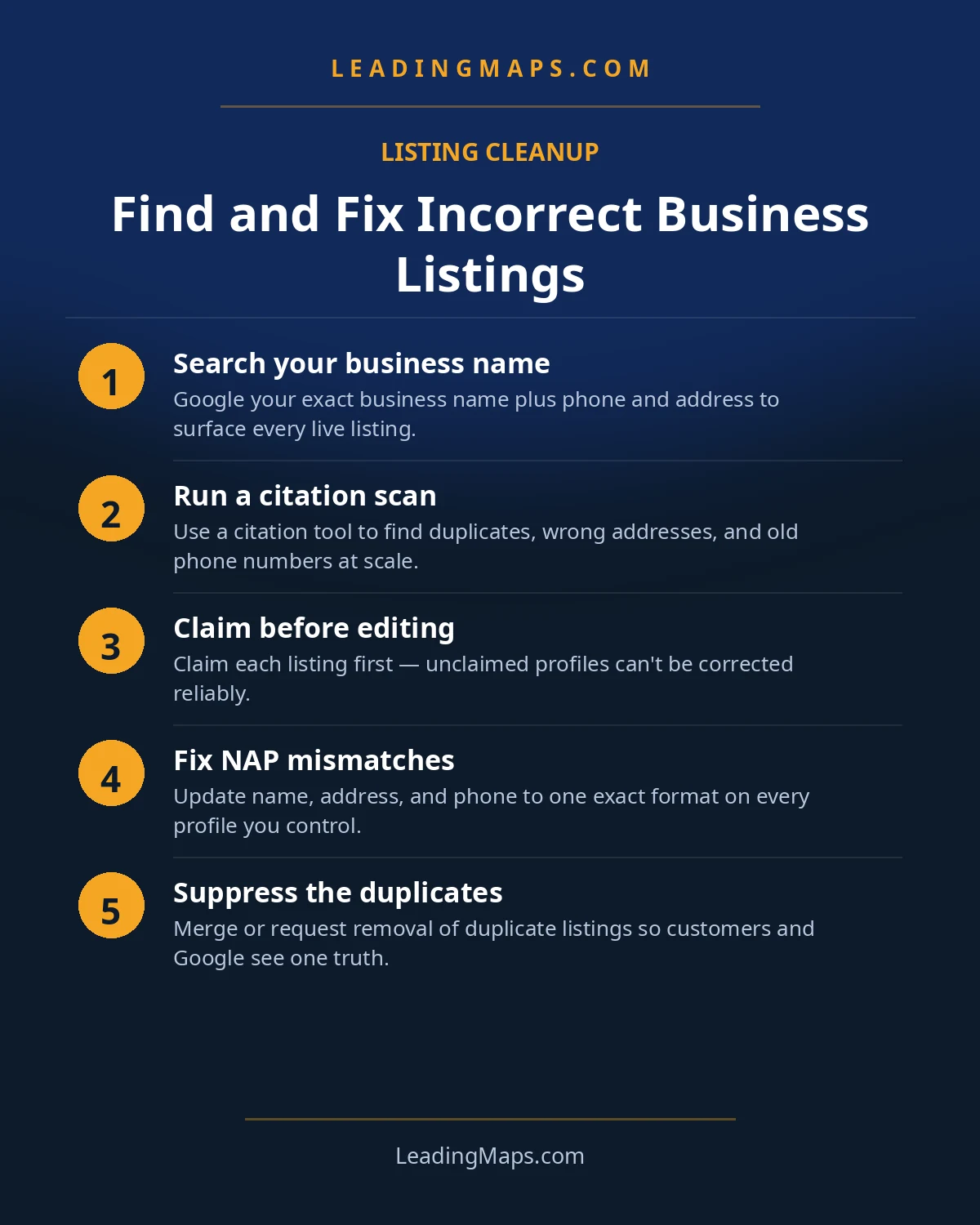
Order matters because the listing ecosystem is a waterfall: aggregators feed directories, directories feed scrapers. Fix a downstream directory before the aggregator above it, and the aggregator's next data push overwrites your correction. Work upstream to downstream:
- 1. Your Google Business Profile. The most visible listing you own. Claim it, correct NAP, hours, and categories first.
- 2. Apple Business Connect and Bing Places. The second tier of maps people actually use.
- 3. The data aggregators. Data Axle, Neustar, Foursquare. Corrections here propagate to hundreds of downstream sites over the following weeks.
- 4. Trade directories. Angi, HomeAdvisor, Houzz, Yelp, BBB, Facebook. High-visibility, and they hold stale data the longest.
- 5. The long tail. Whatever your audit turned up: local chambers, niche directories, old Yellow-Pages-style sites.
- 6. Your own website. Footer NAP on every page must match the locked format exactly. Your site is the source the ecosystem checks against.
Do not buy a 300-citation blast to paper over this. Our citation building work starts from cleanup, because ten consistent listings beat a hundred conflicting ones every time.
The Contractor Traps That Create Bad Listings
Trades businesses generate listing messes in specific, repeatable ways. If any of these sound familiar, they are the root cause to fix so the mess does not regenerate:
- Call-tracking number swaps. A marketing company put a tracking number on your profile and directories, then you parted ways. The tracking number now defines your business across the web. Use your real number on all permanent listings; apply call tracking with dynamic number swapping on your website only.
- Rebrands that stopped halfway. The new name went on the trucks and the website, but the old name still lives on twenty directories. Every old name needs to be claimed and corrected or removed, not left to rot.
- Service-area businesses showing a home address. Plumbers and electricians who work from home should hide the address and set service areas on their profile, per Google's guidelines for service-area businesses. A residential address floating around the directory ecosystem invites both confusion and suggested-edit vandalism.
- Former agencies creating listings you cannot access. Old vendors set up profiles under their own accounts. Reclaim ownership through Google's verification process before touching anything else.
- Suggested-edit hijacking. Competitors and well-meaning strangers can suggest changes to your profile, and Google sometimes applies them. Check your profile's edit history regularly and reject wrong suggestions fast.
The pattern across all five: someone changed the business without updating its identity papers. The cleanup is the same work every time, and the prevention is the same discipline.
Monitoring That Keeps It Clean
Listing ecosystems drift. Aggregators re-ingest old data, directories resurrect dead records, and competitors get creative. A quarterly check takes an hour:
- Quarterly quoted searches of your business name and phone numbers, watching for resurrected wrong listings.
- Monthly profile check for applied suggested edits or info changes you did not make.
- Google Alerts on your business name to catch new listings as they appear.
- One owner of the NAP. Nobody changes the phone number, address, or business name without updating the master list first. Ever.
The best cleanup is the one you never have to repeat. Lock the format, control the changes, and the ecosystem stays settled.
When a listing will not budge, escalate in order: use the platform's own "report a problem" or removal flow first, then the official help community with a clear before-and-after of the wrong data, then a direct support request with documentation (business license, utility bill, or signage photo) proving the correct information. Stubborn cases are usually duplicates or listings owned by someone else's account, and both have a defined resolution path if you bring proof. What never works is creating a third listing on top of two conflicting ones.
The AI-Search Layer: Unverifiable Means Invisible
Here is the 2026 argument for doing this work even if your Google rankings look fine. AI assistants do not trust single sources; they verify businesses by cross-checking name, address, and phone data across many sources before recommending one. When those sources disagree, the assistant's confidence collapses, and it simply does not name you. The homeowner asking ChatGPT for a plumber gets your competitor, not because the competitor is better, but because the competitor's data agreed with itself everywhere it was checked.
The fix is the same cleanup above, plus one addition: LocalBusiness schema on your website, giving machines a canonical source of truth for your NAP, hours, and service area. Consistent listings everywhere plus machine-readable identity on your own site is what makes a business recommendable to AI. Our AEO and LLM optimization service builds on exactly this foundation, with monthly prompt testing across the major assistants.
Listing Questions, Answered.
Search your exact business name in quotes, then your old phone numbers and old addresses in quotes, one at a time. Open every result that looks like your business. Then check the data aggregators (Data Axle, Neustar, Foursquare) and the trade directories (Angi, HomeAdvisor, Yelp) directly, since they feed hundreds of smaller sites that search engines miss.
Fix your Google Business Profile first, then Apple Business Connect and Bing Places, then the data aggregators (Data Axle, Neustar, Foursquare) that feed downstream directories, then the trade directories like Angi, HomeAdvisor, and Yelp, and finally the long tail of smaller sites. Fixing downstream before upstream is wasted work, since aggregator feeds overwrite corrections.
No. Use your real, primary business number on your listings, profile, and website for consistency. Call-tracking numbers create NAP mismatches that confuse search engines and AI assistants. If you want call tracking, apply it dynamically on your website with number swapping, never on the permanent listings that define your business identity.
The core platforms update within days once you claim and correct them. Aggregators typically process changes in 2 to 6 weeks, and downstream directories that pull from aggregator feeds can take 6 to 12 weeks to reflect fixes. Stubborn or duplicate listings may need direct removal requests. Expect the full ecosystem to settle within about 90 days.
Yes, significantly. AI assistants verify businesses by cross-checking name, address, and phone data across the web, and they exclude businesses whose details they cannot confirm. Inconsistent listings do not just weaken Google rankings, they can remove you from AI recommendations entirely. Consistent NAP plus LocalBusiness schema is what makes you recommendable to AI.
Ghost Listings Splitting Your Rankings?
Profile, Maps rankings, citations, reviews, competitors, plus whether AI assistants recommend you. A prioritized action plan, free, no pitch.
- AI visibility check, real homeowner prompts across ChatGPT, Perplexity, and AI Overviews, who gets named.
- Proposal scorecard, what your current or prospective agency should be doing, item by item.
- Competitor gap analysis, what the top 3 in your market are doing that you're not.
Get My Free SEO Audit
Delivered within 48 hours. Yours to keep.